

Blogs
We keep you up to date on the most recent real estate news and events.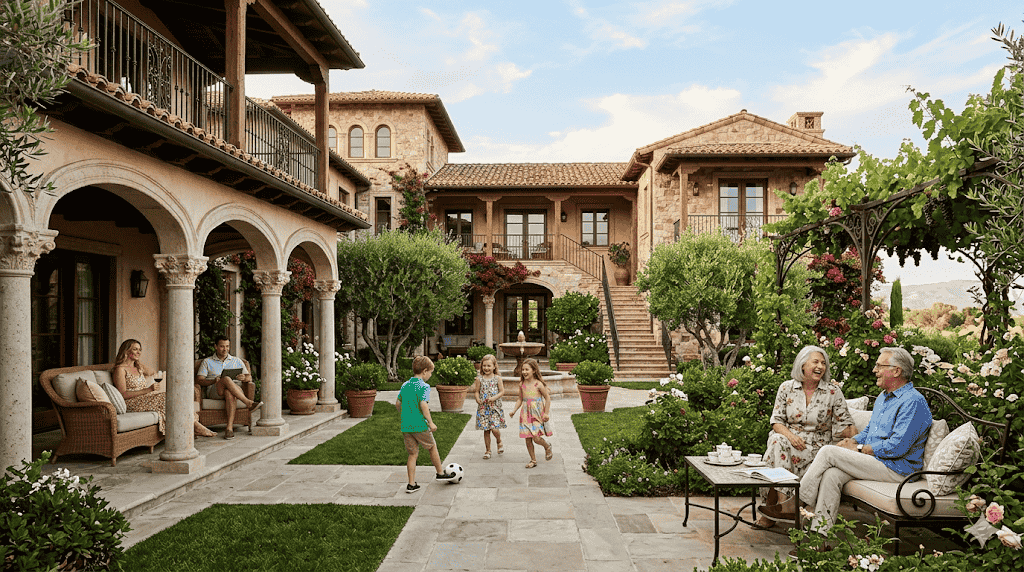
Crafting Legacy: Planning Multi-Generational Homes on Plots for Decades of Living
A House That Outlives Its First Owner
A father in his late thirties stands on a raw piece of earth. He envisions a two-storey structure with a garden for his young children. Fast forward twenty-five years. That same father is now retiring, his children are young professionals, perhaps starting families of their own. The house does not stand still; it breathes. The ground-floor study becomes a bedroom for easier access; the terrace becomes a private apartment for the next generation.
This is the fundamental difference between buying an apartment and investing in a plot. An apartment is a product frozen in time; a plot is infrastructure for continuity.
In the lexicon of Indian real estate, the narrative is often dominated by capital appreciation and location. However, for the discerning High Net Worth Individual (HNI) or the Non-Resident Indian (NRI) looking homeward, the true value of a plotted development lies in its ability to hold a family together through the decades. It is about architectural agility. A home built on a plot is the only asset class that allows you to craft a physical legacy that adapts to the changing seasons of life.
Why Multi-Generational Living Is Returning in India
The 'Joint Family' system was once considered a relic of India’s agrarian past, dismantled by urbanisation and the nuclear family trend. However, there are signs of a gradual resurgence of this model, driven not by necessity, but by choice and demographic pragmatism.
The Demographic Imperative
The World Bank notes that life expectancy in India has risen significantly, crossing 70 years in many urban centres. India’s age structure is shifting rapidly. UN population projections indicate that the proportion of citizens aged 60 and above is expected to rise from just over a tenth of the population in 2022 to roughly one-fifth by mid-century. The implication is structural: longevity is no longer an exception but an increasingly common life trajectory.
The World Bank’s life expectancy data reinforces this shift, with average lifespans now exceeding 70 years across many urban regions.
The Economic & Social Shift
Concurrently, the cost of urban living has skyrocketed. Reports from Knight Frank India consistently highlight that while income levels have risen, the affordability of premium independent real estate in city centres has tightened.
This has given rise to the "cluster living" trend. Families want privacy, but they also crave proximity—for childcare support, for elderly care, and for the sheer emotional security exposed by the pandemic. A plotted home allows for this delicate balance: separate kitchens, shared roots.
Designing for Flexibility, Not Just Today
The mistake most owners make is designing a house for their current lifestyle, rather than their future reality. When commissioning an architect for a plotted development, the brief must shift from "luxury" to "adaptability."
Zoning for Privacy & Connection
The most successful multi-generational homes employ a 'fractal' design.
- Dual-Entry Concepts: Design the layout so that the first floor can be accessed independently via an external stair core or lift lobby. This allows an adult child to live with autonomy, or for the floor to be rented out without intruding on the main household.
- The Courtyard Buffer: Taking a cue from traditional Indian architecture, internal courtyards act as acoustic and visual buffers, allowing generations to share light and air without sharing every conversation.
Structural Planning for Vertical Growth
A plot offers the unique advantage of vertical expansion, but only if the foundation permits.
- Load Planning: Ensure the structural engineer calculates the load-bearing capacity for the maximum permissible Floor Space Index (FSI), even if you are only building a ground-plus-one structure today.
- Service Cores: Pre-plan the shafts for plumbing and electricals to extend upwards. Retrofitting sewage lines for a new floor decades later is invasive and costly.
Universal Design & Senior Readiness
Ideally, a legacy home should delay the need for assisted living facilities. This requires integrating Universal Design principles early on:
- Step-Free Access: Ramps should be integrated into the landscaping rather than added as an afterthought.
- Door Widths: Internal doors should be at least 900mm wide to accommodate walking aids or wheelchairs.
- Ground Floor Suites: Always plan a main suite on the ground floor. Even if used as a guest room today, it is the insurance policy for your future mobility.
The Economics of Planning Across Generations
While the emotional dividends are high, the financial logic of a multi-generational plot is equally compelling.
Asset Preservation vs Asset Division
In many Indian families, property becomes a source of friction when it cannot be divided. An apartment is a single unit; it is binary. A well-planned, plotted home, however, can be legally and structurally stratified.
Furthermore, land historically outperforms built-up structures in preserving capital over long horizons. According to the Reserve Bank of India’s House Price Index (HPI), land prices in tier-1 cities have shown resilience that ageing apartments often lack, as depreciation of the building component eventually drags down the overall value.
Rental & Adaptive Income
A flexible floor plan turns the home into an asset that works for you.
- The Early Years: The upper floors can be rented out to generate yield while the family is small.
- The Middle Years: The family expands and occupies the full structure.
- The Later Years: As the nest empties, the owners retreat to the ground floor and monetise the upper levels once more to supplement their retirement income.
Legal Architecture: Planning Beyond Brick and Mortar
A house may be built with brick, but a legacy is built with paper. Without a robust legal framework, even the most beautifully designed home can become a source of litigation.
Note: The following is strategic information, not legal advice. Always consult a qualified legal professional.
Wills vs. Family Trusts
In India, a Will is the standard instrument of succession, yet it is public upon probate and easily contested. For substantially plotted assets intended to serve multiple generations, a Private Family Trust is often a superior vehicle. A Trust allows you to:
- Ring-fence the asset against potential bankruptcy or divorce claims of beneficiaries.
- Dictate how the property is used (e.g., "The property cannot be sold until the youngest grandchild turns 25").
The Hindu Undivided Family (HUF)
For Hindu, Jain, Sikh and Buddhist families, structuring ownership through a Hindu Undivided Family (HUF) can create tax arbitrage. Since an HUF is assessed independently under the Income Tax framework, rental receipts and other property income are computed separately from individual earnings, which can lower the consolidated tax burden.
Co-Ownership Models
If siblings are co-investing in a plot, distinct "Tenancy in Common" agreements are vital, unlike "Joint Tenancy", where the survivor inherits everything. Tenancy in Common allows each owner to bequeath their specific share of the property to their own heirs, clearly preserving lineage.
Governance & Emotional Sustainability
Buildings rarely fail structurally; families fail emotionally. To ensure the home remains a sanctuary rather than a battleground, "soft infrastructure" is required.
The Family Constitution
For large shared homes, families are increasingly adopting informal charters or "Constitutions." These cover the mundane but friction-heavy aspects of living:
- Maintenance Reserve Funds: A sinking fund where all working adults contribute monthly for structural repairs, painting, and taxes.
- Conflict Resolution: Who decides on major renovations? Is it a vote, or does the head of the family hold veto power?
- Exit Clauses: If one sibling wants to move out and sell their share, does the other sibling have the 'Right of First Refusal'?
Establishing these rules when relationships are harmonious prevents chaos when they are stressed.
Future-Proofing for Unknown Lifestyles
Finally, we must acknowledge that we cannot fully predict the lifestyle of 2045. However, we can build resilience against obsolescence.
Sustainability & Resilience
With water stress becoming a reality in Indian metros (as reported by NITI Aayog), a legacy home must be water-secure.
- Greywater Recycling: Plumb the house to recycle bathwater for garden use.
- Solar Readiness: Design the roof orientation to maximise solar potential, not just for today's panels, but for future, more efficient photovoltaic skins.
The Digital Backbone
The home office is here to stay. Smart cabling, server closets, and dedicated fibre-optic pathways should be as fundamental as plumbing. A legacy home must support the 'Work from Anywhere' economy that the next generation will inherit.
Maintenance and Asset Longevity
Longevity depends on disciplined upkeep. Creating a long-term maintenance calendar, like structural inspections every few years, waterproofing cycles, and façade upkeep, helps preserve value from depreciation.
Land appreciates, but poorly maintained structures depreciate. A legacy property requires stewardship.
Conclusion: From Real Estate to Inheritance Strategy
Buying a plot in a premium township is a transaction. Planning a multi-generational home is a strategy.
It requires a shift in mindset—from viewing a house as a consumer product to viewing it as a generational institution. By combining flexible architecture with robust legal planning and financial foresight, you do more than build a roof over your head. You create a physical anchor for your family’s identity.
In a world of rapid change, the ability to control your environment, to expand without relocating, and to keep your loved ones close is the ultimate luxury. That is the power of the plot
