

Blogs
We keep you up to date on the most recent real estate news and events.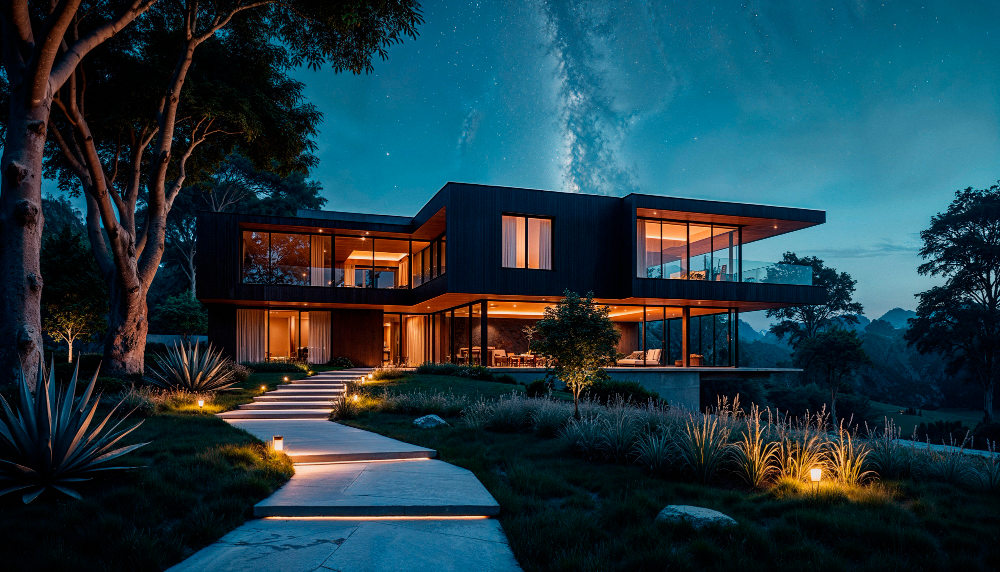
Nightscapes & Light Pollution: Designing Thoughtful Exterior Lighting That Protects the Night Sky
The Vanishing Indian Night
Stand in the centre of a plotted development on the outskirts of Bengaluru or Gurugram tonight and look up. What do you see? In the 1990s, a child standing on that same patch of earth might have traced the belt of Orion or the Pleiades cluster. Today, that child likely sees nothing but a washed-out, sickly orange haze.
This is not merely the fog of pollution; it is the fog of light.
For decades, the Indian real estate narrative has equated brightness with progress. A "well-lit" township meant high-mast floodlights bleaching the streets white, and façade lighting that turned homes into beacons. But as we move toward a more sophisticated definition of luxury living, our relationship with the night must evolve.
True luxury is no longer about how brightly we can banish the darkness. It is about the curation of light. It is the ability to see the stars from your own terrace. In the premium residential sector, the most advanced communities are not those that shine the brightest—they are the ones that understand the value of the dark.
Understanding Light Pollution: The Science Behind the Glow
To design better, we must first understand the pollutant. Light pollution is not simply "too much light"; it is wasted light, directed where it is not wanted and when it is not needed.
A widely cited global mapping study on artificial night brightness, led by Fabio Falchi and colleagues, estimates that over four-fifths of humanity now lives beneath skies altered by artificial light. In India, the problem typically appears in four technical patterns:
- Skyglow: The diffuse halo that hangs above cities after dark. It intensifies because shorter-wavelength light — particularly the blue-heavy output of many LEDs — disperses readily in the atmosphere, amplifying the luminous haze above urban areas.
- Glare: The Illuminating Engineering Society (IES) distinguishes between discomfort glare (which causes an instinctive desire to look away) and disability glare (which actually reduces visibility). Ironically, over-lit security lights often cause disability glare, blinding the very residents they are meant to protect.
- Light Trespass: Light falling where it is not intended or needed—such as a street lamp shining into a main bedroom window, disrupting sleep hygiene.
- Clutter: Overconcentration of competing light sources that erodes visual order, making streetscapes harder to interpret and navigate.
Why It Matters in India
The context for this conversation is uniquely Indian. The country has undergone a rapid lighting revolution, driven largely by the UJALA scheme spearheaded by Energy Efficiency Services Limited (EESL). While this was a triumph for energy efficiency, replacing millions of incandescent bulbs with LEDs, it had an unintended side effect: a massive increase in blue-rich white light in our outdoor environments.
As India’s urban footprint expands—with the UN World Urbanization Prospects projecting our urban population to nearly double by 2050—our plotted townships are pushing into peri-urban and rural zones. These are the frontlines of ecological impact.
Beyond ecology, there is a profound human cost. The World Health Organization (WHO) and circadian scientists have repeatedly flagged that exposure to bright, blue-rich light at night suppresses melatonin production. In our quest to light up our townships for security, we are inadvertently disrupting the biological rhythms of the very families living within them.
Low-Glare Lighting: A Technical Design Framework
For the architect or discerning homeowner planning a residence on a plot, the goal is "Dark Sky Compliance." This does not mean living in the dark; it means lighting with precision.
1. Colour Temperature & Spectrum
The industry standard for outdoor lighting has long been "Cool White" (4000K–6000K). This is an error in residential zoning. "Daylight" hues at night signal the brain to stay alert and scatter more into the atmosphere.
- The Standard: Exterior lighting should be 3000K or lower (Warm White).
- The Ideal: For sensitive zones near gardens or water bodies, 2200K (Amber hue) is superior. It provides visibility without the harsh spectral spike of blue light.
2. Full Cut-Off Fixtures and the BUG Rating
A fixture should never emit light upwards. We use the BUG Rating system (Backlight, Uplight, and Glare) to evaluate luminaires.
- U0 Requirement: For a starry sky, the Uplight (U) rating must be zero. This means using "Full Cut-Off" fixtures where the light source is recessed and hidden within the housing. If you can see the bulb from a distance, it is glare.
3. Mounting Height & Shielding
Lower is often better. High-mast lighting creates broad, undefined washes of light. In a plotted development, low-mounted bollards (shielded to direct light only onto the path) and step lights create a warmer, more intimate scale.
4. Lux Levels & Uniformity
Safety is not a product of brightness; it is a product of uniformity. The eye struggles to adapt between bright pools of light and deep shadows. A consistent, lower level of illumination is safer and more visually comfortable than sporadic high-intensity spotlights.
Turtle-Friendly & Coastal Lighting
For premium developments along India’s vast coastline—from Alibaug to ECR in Chennai—lighting design becomes a matter of life and death for marine biodiversity.
Sea turtle hatchlings rely on the natural horizon—the reflection of the moon and stars on the ocean—to find the water. Artificial lights from beachfront villas disorient them, leading them inland where they perish.
According to the International Dark-Sky Association (IDA), "turtle-friendly" lighting is mandatory for responsible coastal developments. This involves:
- Long-Wavelength Light: Using amber or red LEDs (typically >560 nanometers), which are less visible to turtles.
- Low Profile: Keeping fixtures close to the ground to prevent light visibility from the beach.
- Shielding: Using physical barriers to ensure no point source of light is visible from the shoreline.
Bird-Friendly Lighting in Residential Communities
It is not just the coast that requires care. India lies along the Central Asian Flyway, a critical migratory bird route.
Research by the Cornell Lab of Ornithology indicates that millions of birds die each year from collisions with illuminated structures. Birds migrate primarily at night, navigating by starlight. Upward-facing façade lighting and high-intensity landscape lights can entrap them in a "cone of light," causing them to circle until exhaustion or collide with glass.
For a plotted township, this means:
- Eliminating Up-lighting: Avoid floodlights that shoot up trees or building façades.
- Motion Sensors: Ensuring that purely decorative lights are not running constantly during migration seasons.
- Top-Down Illumination: Lighting architectural features from the top down, rather than the bottom up.
Designing Dramatic Nightscapes Without Over-Illumination
There is a misconception that "sustainable" lighting is dull. On the contrary, low-glare lighting is the hallmark of high-end landscape design. When you remove the glare, you reveal the texture.
Contrast vs. Brightness
In a premium nightscape, we paint with shadow as much as light. Instead of washing a garden wall with a flat floodlight, use grazing—placing a low-lumen fixture close to the wall to highlight the texture of the stone or brick.
Silhouetting and Moonlighting
Rather than blasting a tree with light, place a fixture behind it to create a dramatic silhouette against a wall. Alternatively, use moonlighting techniques: mounting a fixture high in a tree, pointing downward through the leaves to create a dappled, natural shadow pattern on the ground. This mimics the full moon and provides safe, functional light without the visual intrusion of a pole.
Dark Corridors
A master-planned township should intentionally design "dark corridors"—connected swathes of unlit green space that allow wildlife to move and residents to experience true night.
Smart Controls & ESG Value
Sustainability today is measured by the Bureau of Energy Efficiency (BEE) standards and ESG (Environmental, Social, and Governance) compliance. Lighting controls are the bridge between aesthetics and efficiency.
Adaptive Dimming
There is no reason for a residential street to be lit at 100% capacity at 3:00 AM. Intelligent drivers allow community lighting to dim to 30% during off-peak hours, returning to full brightness only when motion sensors detect a vehicle or pedestrian.
Alignment with Green Certifications
Both IGBC (Indian Green Building Council) and LEED offer credits for "Light Pollution Reduction." Implementing these standards not only boosts the development’s green rating but also significantly reduces Operational Expenditure (OPEX) for the Homeowners' Association (HOA) in the long run.
The Future of Responsible Night Design in Indian Townships
The regulatory landscape in India is evolving. We are moving toward a future where "Light Trespass" will likely be treated with the same legal seriousness as noise pollution.
Forward-thinking buyers are already there. The modern HNI is wellness-focused. They understand that a home that respects circadian rhythms is healthier. They recognise that a township that protects its birds and insects is a more vibrant ecosystem.
We are seeing a shift where "Dark Sky Compliance" is becoming as prestigious a marker as a Platinum Green rating. It signals that the developer has thought beyond the boundary wall and considered the community's impact on the planetary scale.
Conclusion
In the end, we must ask ourselves what we want our legacy to be. Do we want to build townships that are visible from satellites, glowing blots on the map? Or do we want to build sanctuaries?
The most sophisticated technology often feels like nature. The most advanced community is not the one that shines the brightest—it is the one that understands when to let the sky speak.
By embracing darkness, we do not lose our way. We simply find the stars again.
